
Image
  • Writing
    • Andy Gavin: Author
    • About my Novels & Writing
    • All Writing Posts
    • The Darkening Dream
      • Buy the Book Online
      • Sample Chapters
      • Reviews
      • Info for Reviewers
      • Press Coverage
      • Awards
      • Cast of Characters
    • Untimed
      • Buy Untimed Online
      • Book Trailer
      • Sample Chapters
      • Reviews
      • Info for Reviewers
      • Press Coverage
      • Awards
      • Cast of Characters
    • Scrivener – Writer’s Word Processor
    • iPad for Writers
    • Naughty Dark Contest
  • Books
    • Book Review Index
    • Favorite Fantasy Novels
    • Andy Gavin: Author
    • The Darkening Dream
      • Buy the Book Online
      • Sample Chapters
      • Short Story: Harvard Divinity
      • Reviews
      • Info for Reviewers
      • Press Coverage
      • Awards
      • Cast of Characters
    • Untimed
      • About the Book
      • Buy Untimed Online
      • Book Trailer
      • Sample Chapters
      • Reviews
      • Info for Reviewers
      • Press Coverage
      • Awards
      • Cast of Characters
    • Naughty Dark Contest
  • Games
    • My Video Game Career
    • Post Archive by Series
    • All Games Posts Inline
    • Making Crash Bandicoot
    • Crash 15th Anniversary Memories
    • World of Warcraft Endgames
    • Getting a Job Designing Video Games
    • Getting a Job Programming Video Games
    • Naughty Dark Contest
  • Movies
    • Movie Review Index
  • Television
    • TV Review Index
    • Buffy the Vampire Slayer
    • A Game of Thrones
  • Food
    • Food Review Index
    • Foodie Club
    • Hedonists
    • LA Sushi Index
    • Chinese Food Index
    • LA Peking Duck Guide
    • Eating Italy
    • Eating France
    • Eating Spain
    • Eating Türkiye
    • Eating Dutch
    • Eating Croatia
    • Eating Vietnam
    • Eating Australia
    • Eating Israel
    • Ultimate Pizza
    • ThanksGavin
    • Margarita Mix
    • Foodie Photography
    • Burgundy Vintage Chart
  • Other
    • All Posts, Magazine Style
    • Archive of all Posts
    • Fiction
    • Technology
    • History
    • Anything Else
  • Gallery
  • Bio
  • About
    • About me
    • About my Writing
    • About my Video Games
    • Ask Me Anything
  • Contact

Archive for Alexandria

Agora – The More Things Stay the Same

Sep09

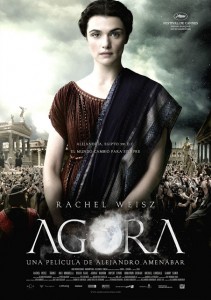
Agora http://movie-trailer.comTitle: Agora

Cast: Rachel Weisz (Actor), Max Minghella (Actor), Alejandro Amenábar (Director)

Genre: Historical Drama

Watched:  August 31, 2013

Summary: Things haven’t changed

_

That this movie got made at all is fairly amazing — and in a totally different way and polar opposite from the vacuous crap oft spewing out of Hollywood (Hansel & Gretel I’m looking at you!).

Agora is set during the tumultuous decades at the end of the 4th and early 5th century AD. It centers around the riots in the Egyptian city of Alexandria between various sects and factions. Between government and mob. Between pragmatists and fundamentalists. Sound familiar? It should. The same sort of thing is occurring today, 1600 years later. The period in the film, known as late antiquity, is an important one, because the order of the modern word was forged in these fires. Yet, most people, including a fair sprinkling of my Ivy League friends, know almost nothing about it. The average American would be lucky to know this is the same Alexandria that hosted the affairs of Cleopatra — over 400 years earlier. They might not distinguish these sandal wearers from the spear toting Spartans of 300 — but that battle occurred 900 years before this one! The ancient world is not one moment, but a vast progression of political and social evolution — all informing our own world.

[youtube http://www.youtube.com/watch?v=RbuEhwselE0]

Back to 400 AD and Alexandria. The city was a peculiar and important experiment. Founded by Alexander the Great in 331 BC on the shores of the Mediterranean at the Nile delta, it was one of the most cosmopolitan in the world, being the poster child for the very idea of Hellenism and the its questioning and philosophic spirit. Perfect, no, but this is the city that housed the Great Library (which desired to obtain a copy of every work written by man) and taught and nurtured 700 years worth of scholars of all faiths. The Hebrew bible was translated here from Aramaic into Greek.
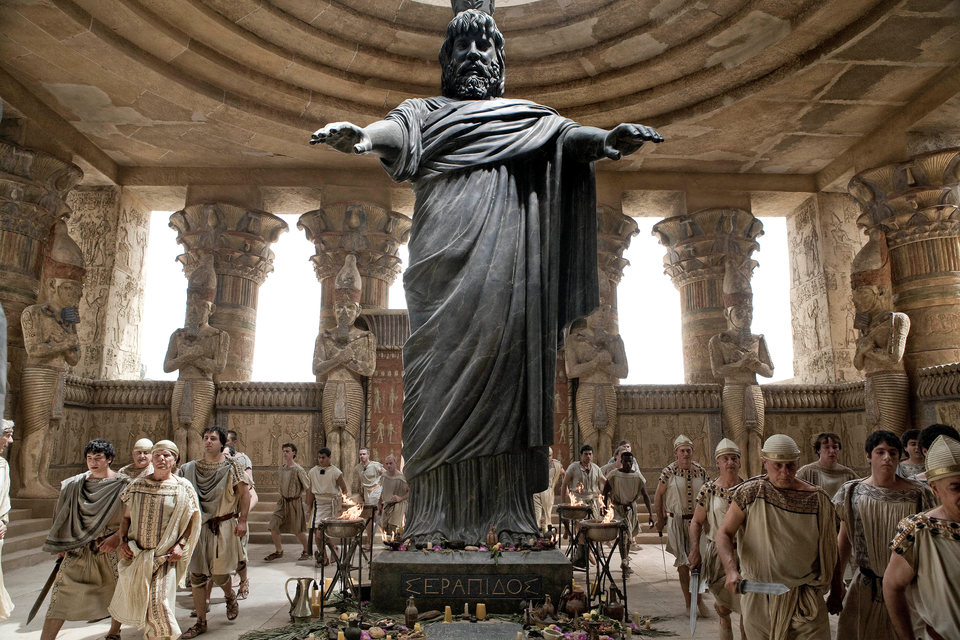
The cult statue of Serapis -- like almost all the cult statues, torn down during these unfortunate years

The cult statue of Serapis — like almost all the cult statues, torn down during these unfortunate years

Agora is not a perfect movie by any stretch, but it does an impressive job of bringing to life the grandeur, sadness, and dust of this ancient place. With superb costumes and by combining grand and detailed sets with judicious CG / Model aerial shots it’s one of the best looking depictions of the ancient world I’ve  seen. It also does a great job with the substance, if not the detail of the history. The central figure is the female philosopher Hypatia, about whom relatively little is known. Her scientific role is a bit extrapolated, but the political situation is fairly faithful. In just a couple of decades Christianity goes from being a minor (and illegal) cult to the one and only state religion of the aging Roman Empire. It is at the hands of men like Saint Cyril of Alexandria (the villain of the film) that established the theological/political principle of religious intolerance that poisons our world today.

Prior to this, men of all nations did their fair (and more) share of killing, usually over political and economic objectives. But in the polyglot world of antiquity, variation of belief was usually taken as a given, separate and outside the world of pragmatic gain (which generally took precedence).

agora04

Hypatia teaches philosophy (science and mathematics). She was known for her worlds on conical surfaces.

People constantly ask me (knowing I’m a Roman history buff) “how did Rome fall?” Well, when you watch how Cyril maneuvers the liberal Imperial Prefect Orestes you find one of the answers to this complex question. This moment, which appears roughly fairly faithful to historical sources , is about as brilliant a bit of political manipulation as the world has ever witnessed. Cyril, preaching from his pulpit, reads to assembled politicians from the bible, outlining his fundamentalist agenda, and then segueing into a question of faith, forces his opponents — in front of the mob — to kneel and declare their faith to the book (held aloft by him!). But what are they kneeling to? The power of God or the ambition of man?

For more Film reviews, click here.
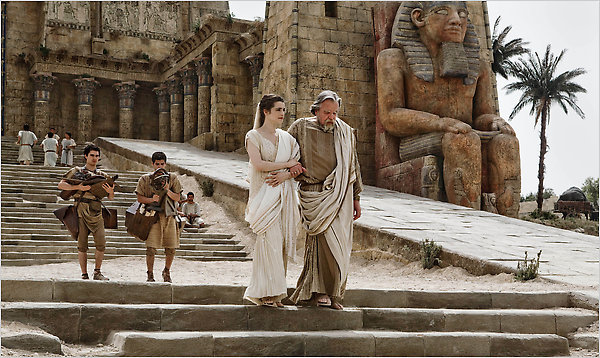
These sets are pretty spectacular
These sets are pretty spectacular

Related posts:

  1. The Pillars of Hercules
By: agavin
Comments (7)
Posted in: History, Movies
Tagged as: Agora, Alejandro Amenábar, Alexandria, Hypatia, late antiquity, Max Minghella, Rachel Weisz

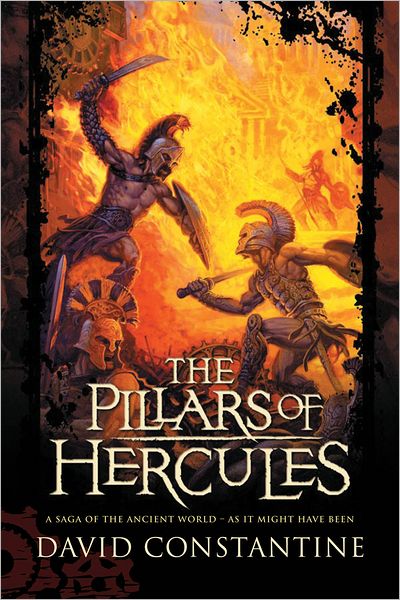
The Pillars of Hercules

Mar25

Title: The Pillars of Hercules

Author: David Constantine

Genre: Historical Fantasy

Length: 411 pages

Read: March 16-17, 2012

Summary: Bronze-punk!

_

The Pillars of Hercules is a very fun read and takes a serious stab at something I haven’t really seen before and is very much up my alley. For lack of a better term: bronze-punk.

What we have — for at least the first two thirds — is a combination alternate history and speculative technology book, set in 330 BC. Now this is a fun and tumultuous period, that of Alexander the Great and one which was to see (in real life) immense changes in the euro-Asian political scene which shaped the world we know. At the political level, David Constatine is clearly knowledgable and very fond of the period. He speculates on a number of specific deviances from real history: The success of Athens‘ disastrous (in real history) Sicilican campaign, giving rise to a stronger Athenian Empire. And the survival of both Phillip and Alexander past their fated dates. I found this play out fascinating and entirely reasonable.

To this, he adds a rather extreme amount of extended technology based both on secret discoveries from previous (read Atlantian) civilizations, and real ancient tech amplified by geniuses such as Aristotle who are astoundingly more practical (in the vein of Tony Stark x 1000) then their real life counterparts. Most of these inventions are weapons and war machines. Plenty of this tech does have precedents in the ancient world such as steam engines. But in a society where the cost of labor was nearly zero (slavery being more the rule than the exception) there was no impetuous for mechanization (That would take the depopulating effect of the middle ages and the plague to bring about). I found this stuff fantastic fun. But Constantine does take it a bit far for little purpose in the form of semi-sentient gear work golems and the like (not that I don’t have clockwork men if my own in Untimed). The almost magic tech of the “gods” was also a little much. But it was good fun.

Against this rather magnificent backdrop we have an adventure and war story of lightning pace and heroic proportions. Point of view-wise about two-thirds of the story is told by a Gaulic mercenary who is along for the ride with a Persian noblewoman “in the know” about some of this extreme tech in her quest to stop Alexander from taking over the world. The big political scope of the book involves Alexander, having survived his in-real-life fatal illness/poisoning, and who goes on to try and conquer the Western Mediterranean from the Athenian Empire. In the other third of the narrative we see Akexander’s plots and conquests through the eyes of a couple of his generals and foes. One of these, his right hand man, gets a good number of pages and has a developed POV. Most of the others serve as human cameras.

The first two-thirds of the book is therefore mostly glorious (and very fun) high swashbuckling action on the part of the merc or generals in the midst of a near-continuous series of huge battles, sieges, daring breakins, escapes, and naval chases. There isn’t much focus here on emotions of character arcs. The characters aren’t cardboard either, just fun, and free of internal serious flaws that need resolving. And the action is often so grand as to completely stretch the reality factor. But it is good fun and reminds me of some of the best Philip Jose Farmer.

Then at about the 70% mark most of the threads pass west of the titular Pillars of Hercules and things get weirder. Not that the pace of action lets up, but instead of being set in the likes of Alexandria, Athens, Syracuse, or Carthage, literally descends into a sort of mechanized Hades filled with machines of the gods. While well executed, and providing the book with a larger mythic framework, I personally can’t help but think Constantine went too far. That the overall effect would have been a little more satisfying sticking to this fantastic world closer to our own.

Still, highly, highly recommended.

For more book reviews, click here.

Or read about my own historical fantasy novel here.

Related posts:

  1. Julian – The End of an Era
  2. Some Ideas Never Die
  3. Book Review: A World Undone
  4. Book Review: The Last Colony
By: agavin
Comments (0)
Posted in: Books
Tagged as: Alexander, Alexander the Great, Alexandria, Athens, Atlantic Ocean, Atlantis, David Constantine, Hercules, Pillars of Hercules, The Pillars of Hercules
All Things Andy Gavin
Copyright © 2026 All Rights Reserved
Programmed by Andy Gavin